
Export work is full of changing documents, missing evidence, shifting deadlines and dependencies across people. This is where agents are useful. It is also where careless automation can create expensive commitments.
Use agents where the work is variable
An agent can monitor tender sources, read an addendum, identify a changed requirement, request a certificate from the right owner and update the submission plan. It can carry context across steps that normally live in email, spreadsheets and shared drives.
This is different from asking a chatbot to write a proposal. The agent is doing commercial coordination. It knows the opportunity, the factory record, the evidence sources, the deadline and the pending decisions.
Use rules where the truth must be exact
Money, eligibility, identity, versions and external actions should not depend on improvisation. A deterministic control should calculate totals, stop an expired certificate, bind the approved submission package and prevent unsupported claims from entering the bid.
The useful architecture is therefore layered. Agents handle interpretation and coordination. Rules protect facts and gates. A named person approves price, promise and external action.
Keep authority visible
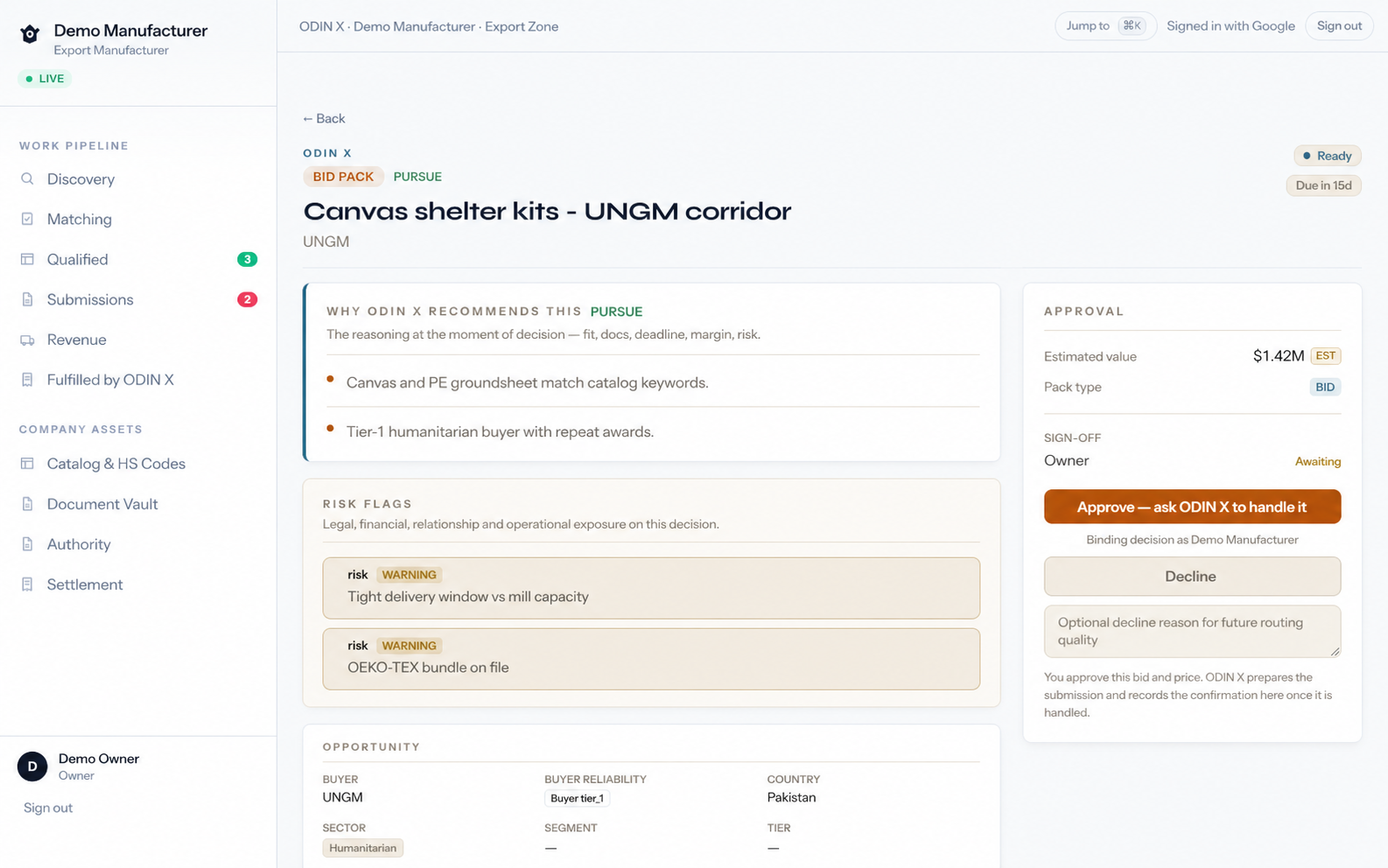
Human approval is not a ceremonial button at the end. The manufacturer needs to see the exact bundle being approved, the evidence behind it, the risks that remain and the action that will follow.
ODIN X is built around this division of labour. Agents handle the work between decisions. The manufacturer retains the authority to decide what the factory can promise and when it should proceed.
Measure the outcome, not the amount of AI
The right question is not how many agents are running. It is whether the factory found more relevant demand, rejected weak pursuits earlier, submitted stronger bids, learned from buyer feedback and delivered wins with less context loss.
Agentic AI earns its place when it moves the commercial work while making authority clearer, not weaker.